The General Architecture of Computing as a Human Activity
From Philosophy to Artificial Intelligence
What if computing wasn’t just about machines — but about deeply human processes like reasoning, structuring ideas, and solving problems?
In a world driven by technology, we often forget that computing is not fundamentally about machines. Instead, it is an extension of the way humans think, organize knowledge, and approach problem-solving. This article presents a conceptual architecture of computing rooted in human activity, from philosophical reflection to the modern frontiers of Artificial Intelligence.
1. The Human Roots of Computing
Everything starts with Systemic Thinking — the philosophical ability to see wholes, relationships, and interdependencies. This is not new: ancient philosophers were already applying it to ethics, politics, and nature.
From there, Logic emerges as a tool to formalize thought. Logic brings structure and precision to our reasoning, making it possible to express ideas in ways that are consistent, testable, and—eventually—computable.
Next comes Computational Thinking, a concept that bridges human reasoning with algorithmic problem solving. It’s the mindset that allows us to deconstruct problems, identify patterns, and design processes that machines can execute.
2. Math: The Great Connector
At the heart of computing lies Mathematics. It’s the universal connector — the language that allows logic and computation to meet real-world problems.
Every path in this architecture, whether it leads to software, data, or AI, is grounded in mathematical foundations. Whether it’s set theory, probability, linear algebra or discrete structures, math is what gives computational thinking its operational power.
3. The Modern Trifecta: Software, Data, and AI
Computational thinking and math give birth to three major fields in modern computing:
Software
Where ideas become instructions. This includes systems programming, web/mobile development, scripting, and automation — all translating human intent into functioning processes.
Data
Where we quantify, organize, and interpret the world. Data Analytics, Data Engineering, Business Intelligence — these disciplines help us make sense of complexity through measurement.
Artificial Intelligence
Where we design systems that learn and adapt. AI is the natural evolution of computational thinking applied recursively: machines that think about thinking.
4. Visualizing the Architecture
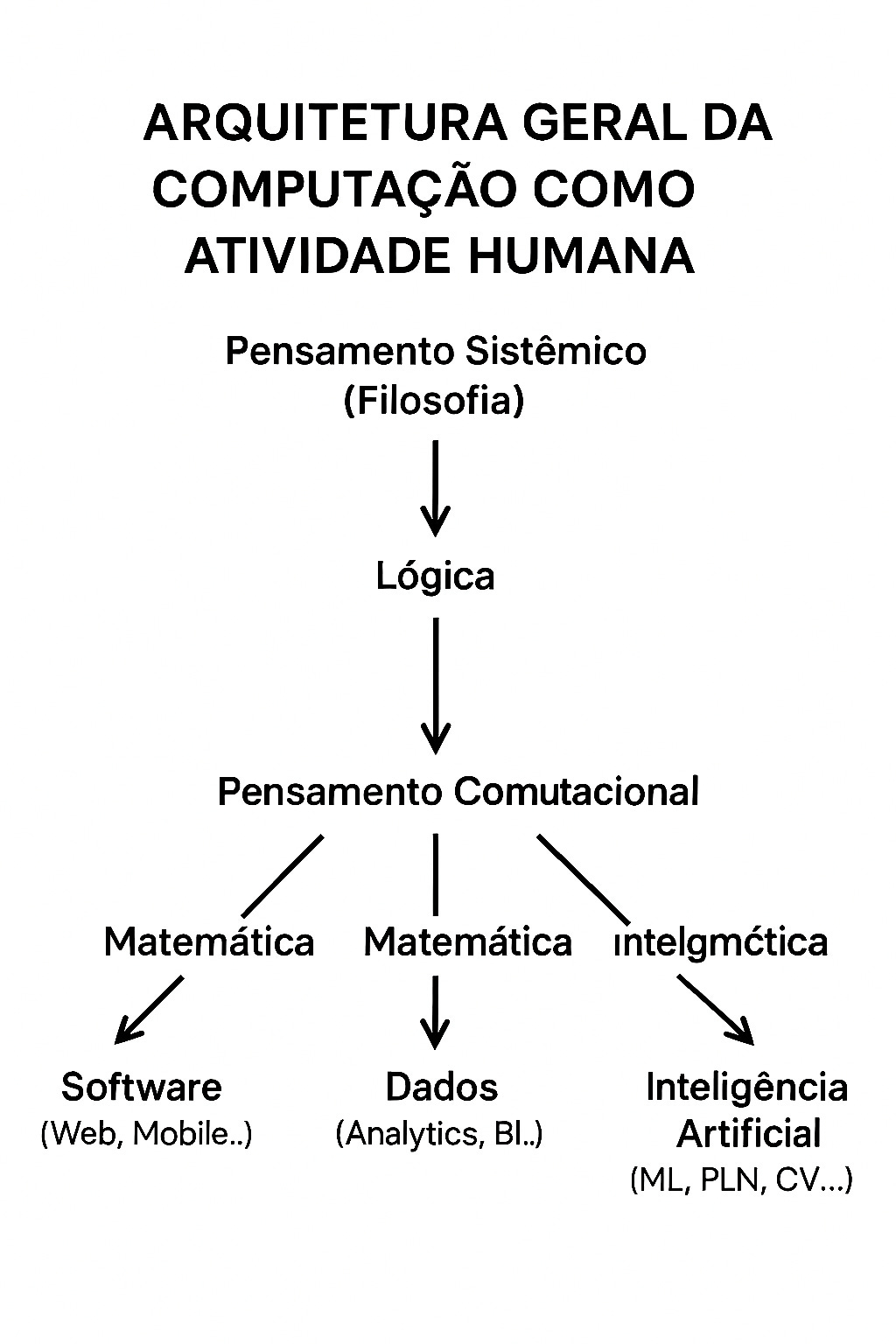
This diagram reveals the deep continuity between abstract thought and technical execution. What we build with code, data, and models is rooted in how we think as humans.
Maybe the future of computing is not just faster machines — but deeper ways of thinking.
Written by Rafael Sanches